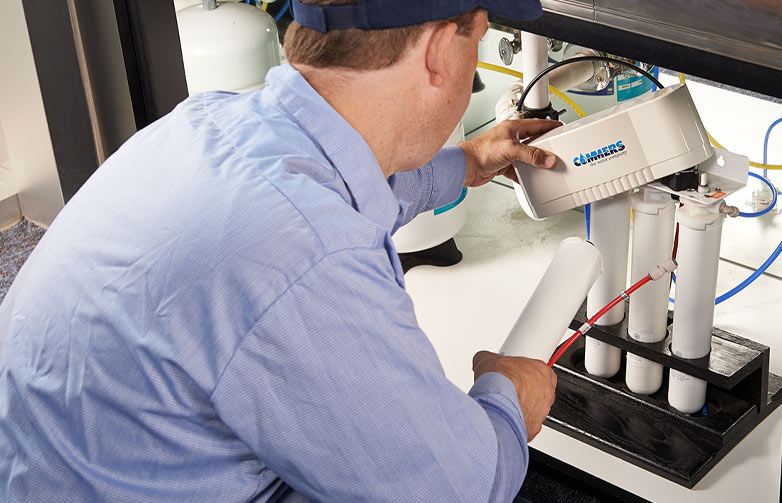


Regular water softener maintenance helps keep your system running as intended and lets you catch problems before they affect soft water. Homeowners can handle basic tasks such as checking salt levels, looking for salt bridges, and watching for leaks. A professional checkup can go deeper by evaluating system operation, the brine tank, control valve, resin performance, regeneration, and other components that affect how well your softener works.
A water softener can work quietly in the background for years, which makes it easy to forget about until something changes. Maybe spots start appearing on glassware again. Soap doesn’t lather the way it used to. The system seems to be using more salt than normal. Or you notice that it is regenerating more frequently.
Regular water softener maintenance can help identify these changes before they turn into bigger performance problems. Maintenance also confirms the system is regenerating properly, using salt as expected, and continuing to reduce the calcium and magnesium responsible for hard water.
For Minnesota homeowners, routine maintenance can be especially useful because hard water is common throughout the state. But maintaining a softener doesn’t mean scheduling complicated service every few months. Some checks are easy to handle yourself, while others require the tools and experience of a water treatment professional.
Here’s what to watch, what you can do at home, and when it makes sense to schedule professional water softener service.
Quick Facts About Water Softener Maintenance
Your softener needs enough salt to create the brine used during regeneration.
Hard water returning, unusual salt consumption, leaks, or unexpected regeneration can indicate a problem.
Salt bridges, mushing, and excessive residue can interfere with normal brine production.
Persistent performance problems may involve the valve, resin, regeneration cycle, settings, or other components that require deeper troubleshooting.
Why Does Water Softener Maintenance Matter?
Water softener maintenance helps confirm that your equipment is regenerating correctly and continuing to reduce hardness minerals from your home’s water.
A typical ion-exchange water softener uses resin beads to capture calcium and magnesium. Eventually, those beads reach capacity and must be regenerated. During regeneration, a concentrated brine solution recharges the resin so it can continue softening water.
That process depends on several parts working together. The brine tank needs sufficient salt. The control valve needs to move through the regeneration cycle properly. The resin needs to remain capable of exchanging hardness minerals. System settings also need to match the home’s water conditions and usage.
When one part isn’t working correctly, you may notice hard water symptoms returning even though the softener still appears to be running.
Routine checks help homeowners catch obvious issues, while professional maintenance can investigate problems that aren’t visible from the outside.
How Often Does a Water Softener Need Maintenance?
There is no single maintenance schedule that applies to every water softener. The right schedule depends on your equipment, water hardness, household water consumption, system age, manufacturer recommendations, and whether the softener has a history of performance problems.
Homeowners can periodically check the brine tank and watch for changes in system performance as part of normal household maintenance. Your equipment manual may also specify particular inspection, cleaning, or service intervals.
Professional service may be appropriate when something changes or when the system hasn’t been evaluated for an extended period. Older equipment or systems treating particularly challenging water may also benefit from more frequent attention.
Professional Insight
Maintenance shouldn’t be based on the calendar alone. Changes in water quality, salt consumption, regeneration frequency, or system behavior can be more useful clues that your softener needs attention.
What Should You Check in the Brine Tank?
Check the brine tank for adequate salt, unusual residue, salt bridges, and other conditions that could interfere with brine production.
The brine tank holds the salt your system uses during regeneration. If the salt supply gets too low, the system may not be able to regenerate the resin properly.
Simply seeing salt inside the tank doesn’t always mean everything is working correctly, either.
A salt bridge is a hardened layer of salt that forms above the water. The tank may look full from above even though the salt underneath is no longer reaching the water properly.
Salt mushing happens when dissolved and recrystallized salt forms a thick material near the bottom of the tank. This can also interfere with normal brine production.
Excessive sediment or residue can be another reason to clean the brine tank, particularly if it has accumulated over time.
Don’t wait until your brine tank is completely empty before checking it. Get familiar with what the tank normally looks like and how quickly your household typically uses salt. A sudden change in salt consumption can be an early clue that something has changed.
How Do You Know If the Resin Is Still Working?
One of the most noticeable signs of a resin or regeneration problem is the return of hard water even though the softener has salt and appears to be operating.
The resin tank contains the beads responsible for removing calcium and magnesium from the water. Unlike the brine tank, the resin isn’t something most homeowners can meaningfully inspect during a quick maintenance check.
Instead, watch what is happening around your home.
New scale around faucets, increased spotting on dishes and glassware, changes in how soap lathers, or other familiar hard-water symptoms can indicate that the system isn’t providing the same level of softening it once did.
Those symptoms don’t automatically mean the resin needs replacement. A regeneration problem, incorrect settings, a salt bridge, valve issue, or another system problem could produce similar symptoms.
Testing the water and evaluating the softener can help narrow down the cause before parts are replaced unnecessarily.
Why Is the Control Valve Important?
The control valve manages water flow and the regeneration cycle, making it one of the most important operating components in a water softener.
Modern demand-initiated systems may track water usage and regenerate when needed, while other equipment may operate according to different programming. Either way, the valve needs to complete the necessary stages of regeneration for the resin to be properly recharged.
If the valve isn’t operating correctly, the softener may regenerate at the wrong time, fail to complete a cycle, use an unusual amount of water or salt, or allow hard water to return.
Control-valve diagnostics generally go beyond basic homeowner maintenance. If your system behaves unusually or displays an error, check the owner’s manual first. Persistent issues are a good reason to schedule professional service.
Does Water Pressure Affect a Water Softener?
Water softeners are designed to operate within a specified pressure range, and abnormal household water pressure can affect equipment operation.
If you’ve noticed a significant change in water pressure throughout your home, don’t automatically assume the softener is responsible. Plumbing restrictions, filters, pressure equipment, valves, and other household components can also affect flow or pressure.
However, if a pressure change appears at the same time as other softener problems, a professional can determine whether the treatment system is contributing to the issue.
Water around the softener shouldn’t be ignored. Check nearby plumbing and connections if you can do so safely. If water continues to leak from the equipment or you cannot identify the source, bypass the softener if you know how and contact a professional.
Does a Water Softener Need to Be Cleaned or Sanitized?
Cleaning and sanitization needs depend on the equipment, water source, system history, and manufacturer recommendations.
The brine tank can accumulate sediment or residue over time, making occasional cleaning appropriate for some systems. The frequency will depend partly on the salt being used and the conditions inside the tank.
Sanitization may also be recommended under certain circumstances, such as after specific service procedures or when directed by the equipment manufacturer. It shouldn’t be treated as a substitute for testing or other treatment when there is a concern about drinking-water safety.
If you aren’t sure whether your particular system needs cleaning or sanitization, follow its manual or ask a qualified water treatment professional.
What Water Softener Maintenance Can You Do Yourself?
Homeowners can safely handle several basic water softener maintenance checks without disassembling the equipment.
Between professional service visits, you can:
- Check the salt level in the brine tank.
- Use a salt product recommended for your equipment.
- Look for signs of salt bridging or mushing.
- Watch for excessive sediment or residue.
- Check the area around the softener for leaks.
- Pay attention to unusual noises or regeneration patterns.
- Watch for hard-water symptoms returning.
- Note unexplained changes in salt consumption.
These observations can also give a technician useful information if professional troubleshooting becomes necessary.
If you want more guidance on keeping your equipment running properly, Commers has additional resources covering water softener maintenance and common system problems.
When Should You Call a Water Softener Professional?
Professional service makes sense when basic maintenance doesn’t correct the problem or when troubleshooting requires inspecting internal components.
Consider having the system evaluated if you notice recurring hard water, persistent leaks, unusually frequent regeneration, unexplained salt consumption, error messages, or repeated brine-tank problems.
A professional can evaluate the complete system rather than treating one symptom in isolation. Depending on the equipment and problem, that may involve checking regeneration, system programming, valve operation, brine draw, water hardness, resin performance, and other operating conditions.
This is also where water testing can be valuable. Knowing the actual hardness and characteristics of the incoming water helps determine whether the softener is set up appropriately for the home.
Water Softener Maintenance for Minnesota Homes
Minnesota’s hard water makes water softeners an important piece of equipment in many homes. That also makes routine maintenance worth paying attention to.
Commers has served the Twin Cities since 1947 and has locations in Blaine, Golden Valley, and Burnsville. Its team works with homeowners to evaluate water conditions, maintain existing treatment equipment, and troubleshoot softeners that are no longer performing as expected.
Rather than waiting for a complete breakdown, paying attention to changes in your water and equipment can help you know when it’s time for a closer look.
Water Softener Maintenance FAQs
How often should I check my water softener?
Check your brine tank periodically and pay attention to changes in salt use, regeneration, water quality, or equipment operation. Professional maintenance frequency depends on your particular equipment, water conditions, system age, and manufacturer recommendations.
What are signs that my water softener needs maintenance?
Common warning signs include hard-water symptoms returning, unusual salt consumption, frequent regeneration, leaks, error messages, changes in system behavior, and recurring salt bridges or brine-tank problems.
Can I maintain my water softener myself?
Yes. Homeowners can check salt levels, look for salt bridges, monitor the area for leaks, and watch for changes in water quality or system behavior. Internal diagnostics, valve problems, resin issues, and repairs are generally better handled by a professional.
Why is my water softener using more salt than usual?
Higher water use can increase salt consumption, but an unexplained change may also be related to system settings, regeneration frequency, water hardness, or an equipment problem. Persistent increases are worth investigating.
Should I clean my water softener brine tank?
A brine tank may need occasional cleaning if sediment, residue, or salt buildup accumulates. Follow your equipment manufacturer’s instructions for cleaning procedures and recommended frequency.
Why is hard water coming back even though my softener has salt?
Having salt in the tank doesn’t guarantee that the system is regenerating properly. Salt bridging, incorrect settings, valve problems, resin performance, or other system issues can allow hard-water symptoms to return.
Keep Your Water Softener Working the Way It Should
Water softener maintenance doesn’t have to be complicated. Checking the salt, watching the brine tank, and paying attention to changes in your water can tell you a lot about how your system is performing.
The key is knowing where basic maintenance ends and professional troubleshooting begins. If hard water returns, salt consumption changes unexpectedly, leaks develop, or your softener simply isn’t behaving normally, an evaluation can help identify the cause instead of relying on guesswork.
For Minnesota homeowners, Commers can help evaluate your water and water softener to determine what your system needs to continue operating properly.