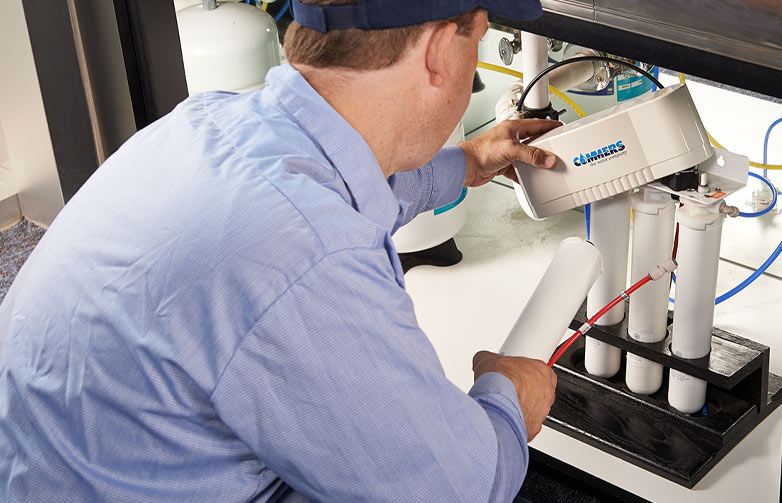



No single reverse osmosis filter replacement schedule fits every system. Different cartridges and membranes have different service lives, and replacement timing can also depend on water quality, household usage, and the manufacturer’s specifications. Follow your RO system’s recommended service intervals, and watch for changes in flow, taste, odor, or overall performance that may indicate it’s time for maintenance.
Reverse osmosis filter replacement is one of the most important parts of maintaining an RO drinking water system. Your system relies on multiple filtration stages, and those components don’t last forever.
Waiting until your drinking water tastes different isn’t the best way to decide when to change them, either. A filter can reach the end of its recommended service life without producing an obvious change you can see, smell, or taste.
So, how often should you replace RO filters?
The most reliable answer comes from your system manufacturer. The cartridge type, your household’s water usage, incoming water quality, and the specific RO system can all affect the right service interval.
Here’s how the different stages work, which warning signs deserve attention, and why staying ahead of filter replacement matters.
Quick Facts About RO Filter Replacement
Sediment, carbon, membrane, and post-filtration components perform different jobs and may have different replacement intervals.
Some filters can reach the end of their recommended service life without creating an obvious taste or odor change.
A noticeable drop in water production or faucet flow may indicate a clogged filter or another system issue.
Cartridges aren’t necessarily interchangeable, even when they look the same size.
How Often Should You Replace Reverse Osmosis Filters?
Replace your RO filters according to the service intervals specified by the system manufacturer rather than relying on one universal schedule.
A reverse osmosis drinking water system typically contains several stages. Depending on the equipment, those may include a sediment prefilter, one or more carbon filters, the RO membrane itself, and a final polishing filter.
Each component has a different job. That also means you don’t necessarily need to replace them at the same time.
Manufacturers may base a filter’s service life on time, gallons treated, or other operating conditions. Incoming water characteristics and how much drinking water your household uses can also affect actual filter life.
For that reason, your system manual or manufacturer’s maintenance specifications should always be the starting point for determining when a particular cartridge needs replacement.
The Most Important Rule
Don’t assume every cartridge in your RO system follows the same schedule. Identify your system and its individual filtration stages first, then follow the replacement requirements for those components.
What Do the Different RO Filters Do?
An RO system uses multiple treatment stages because each component is designed to perform a different part of the filtration process.
Sediment Prefilter
A sediment filter is generally positioned early in the treatment process. It captures particulate matter before it reaches downstream components.
As trapped material accumulates, the filter can become increasingly restricted. Staying on top of replacement helps maintain normal flow and protects later stages of the system.
Carbon Prefilter
Carbon filtration can reduce substances such as chlorine and compounds that affect taste and odor, depending on the cartridge and its certifications.
In an RO system, prefiltration can also be important for protecting the membrane. The exact configuration depends on the equipment and source water.
Reverse Osmosis Membrane
The membrane is the component that gives reverse osmosis its name. Water is forced through a semipermeable membrane designed to reduce dissolved substances while sending a concentrated waste stream to the drain.
The membrane generally follows a different service schedule than disposable prefilters, so it shouldn’t automatically be replaced simply because another cartridge is due.
Post-Carbon or Polishing Filter
Many systems include a final filtration stage between the storage tank and drinking-water faucet. This stage is commonly used to polish the water’s taste before dispensing.
Like the other cartridges, it needs to be replaced according to the requirements of the particular RO system.
What Are the Signs Your RO Filters Need Replacement?
Reduced flow, changes in taste or odor, unusual system performance, and reaching the manufacturer’s specified service interval can all indicate that RO maintenance is due.
Watch for several common clues:
- A noticeable decrease in flow from the RO faucet
- The storage tank taking unusually long to refill
- A new or unusual taste or odor
- Changes in normal system operation
- A filter-change indicator or service notification
- The cartridge reaching its recommended service interval
These symptoms aren’t proof that a particular filter has failed. Low flow, for example, can have several possible causes within an RO system.
That’s why troubleshooting matters. If replacing a cartridge doesn’t correct the problem—or you aren’t sure which stage is responsible—a professional drinking water system service can evaluate the complete system.
Taste and odor are useful clues, but they aren’t reliable indicators of every filter’s remaining capacity. Your senses can’t detect some contaminants. Follow the manufacturer’s replacement schedule even when the water still seems normal.
What Happens If You Don’t Replace RO Filters?
Delaying filter replacement can reduce flow and may compromise the treatment performance the system was designed to provide.
Filters have limited capacity. Mechanical filters gradually collect particles, while adsorptive media such as activated carbon have a finite amount of surface area available to capture certain substances.
Once that capacity is used, the cartridge may no longer perform as intended.
A clogged prefilter can also restrict flow through the system. And because RO treatment relies on multiple stages working together, neglecting one component can affect overall operation.
Regular maintenance helps each stage do its intended job, rather than waiting for an obvious performance problem.
Can You Replace Reverse Osmosis Filters Yourself?
Some RO systems are designed for straightforward cartridge replacement, but whether DIY service makes sense depends on the equipment and your comfort level.
For example, Commers’ current RO-75 system uses click-in lock cartridges and color-coded cartridges designed to help maintain the proper filter sequence. Other systems may use different housings, fittings, cartridges, or service procedures.
If you replace filters yourself, follow the manufacturer’s instructions carefully. That includes using the correct replacement cartridges, following any flushing or sanitization procedure specified for the equipment, and checking connections for leaks after service.
Don’t assume a cartridge is compatible simply because it fits. Replacement filters can differ in materials, specifications, and certified performance.
Keep a record of the date each cartridge is replaced. Because different stages may follow different service intervals, a simple maintenance record can eliminate the guesswork the next time your system is due for service.
Why Does the Correct Replacement Cartridge Matter?
The right cartridge helps ensure your RO system continues operating according to its intended design and performance specifications.
Water filter cartridges aren’t universally interchangeable. A replacement may look similar to the original and even fit inside the housing while having different filtration characteristics.
NSF advises consumers to use the proper replacement cartridge and follow the manufacturer’s recommended replacement interval. That’s especially important when a system has specific certifications for contaminant reduction.
If you aren’t sure which filter your system requires, identify the model before ordering replacements or schedule professional service.
Should the RO Membrane Be Replaced With Every Filter Change?
No. The RO membrane typically has its own maintenance requirements and shouldn’t be replaced every time you change a prefilter or postfilter.
The membrane performs a different job and may have a different expected service life. You can also evaluate its condition using system performance and water-quality measurements, rather than assuming it needs replacement based on another filter’s schedule.
If you’re experiencing declining performance, a technician can help determine whether the issue involves a prefilter, membrane, storage tank, pressure, flow restriction, or another component.
Replacing the correct component avoids unnecessary maintenance while helping restore the performance you expect from the system.
How Can You Make RO Maintenance Easier?
The easiest way to manage RO maintenance is to know your system, follow its service schedule, and keep a simple record of filter changes.
Start by identifying the exact make and model. Keep the owner’s manual or digital documentation somewhere accessible, and note each replacement date.
You can also:
- Use replacement cartridges specified for your system.
- Pay attention to changes in normal faucet flow.
- Don’t ignore unusual taste or odor.
- Check for leaks after cartridge replacement.
- Follow required flushing procedures.
- Schedule service when performance changes unexpectedly.
If keeping track of multiple filters isn’t something you want to manage yourself, professional filter replacement can make routine maintenance simpler.
Reverse Osmosis Filter Service for Twin Cities Homes
Commers has served the Twin Cities since 1947 and provides reverse osmosis systems, filter replacement, maintenance, and water treatment support for local homeowners.
Commers currently offers several RO drinking water options, including systems with quick-change cartridge designs. Its service team can also help homeowners identify the correct replacement filters and address RO systems that aren’t performing as expected.
With locations in Blaine, Golden Valley, and Burnsville, Commers serves communities throughout the Twin Cities metro.
If you aren’t sure when your filters were last changed—or your drinking water system isn’t working the way it normally does—professional service can take the guesswork out of determining what needs attention.
Reverse Osmosis Filter Replacement FAQs
How often should reverse osmosis filters be replaced?
Replacement intervals vary by system and filter stage. Follow the manufacturer’s specified service interval for each cartridge and membrane rather than using one universal schedule.
How do I know if my RO filter is bad?
Possible signs include reduced faucet flow, slower tank refilling, changes in taste or odor, unusual system operation, or a filter that has reached its recommended service interval. These symptoms can have multiple causes so that persistent problems may require troubleshooting.
Do all RO filters need to be replaced at the same time?
Not necessarily. Sediment filters, carbon filters, RO membranes, and polishing filters perform different jobs and may have different service intervals. Follow the maintenance schedule for your specific system.
Can I replace reverse osmosis filters myself?
Some RO systems are designed for relatively simple cartridge changes. Always follow the manufacturer’s instructions, use the correct replacement cartridges, complete any required flushing procedures, and check for leaks afterward. Professional service is an option if you aren’t comfortable performing the maintenance.
Does the RO membrane need to be changed every year?
Not necessarily. RO membrane service life varies by system, incoming water conditions, usage, and manufacturer specifications. Follow the recommended interval and evaluate system performance rather than automatically replacing the membrane on a fixed annual schedule.
Can I use any replacement filter that fits my RO system?
No. A cartridge that physically fits may not have the same materials, filtration specifications, or certified performance as the recommended replacement. Use cartridges specified for your particular RO system.
Keep Fresh Filters Working for Your Drinking Water
Your reverse osmosis system doesn’t need constant attention, but its filters do need routine replacement. Keeping up with those service intervals helps maintain normal flow and allows each treatment stage to continue performing as designed.
Don’t rely on taste alone or wait until the faucet slows to a trickle. Know which filters your system uses, follow the manufacturer’s schedule, and watch for changes in normal performance.
If you’re due for a filter change or aren’t sure when your system was last serviced, Commers can help identify what your equipment needs and get your RO maintenance back on schedule.